How to search clipboard history with ClipsX
Find old copied text, overcome Windows clipboard limits, and search your history by keywords, concepts, or natural questions.
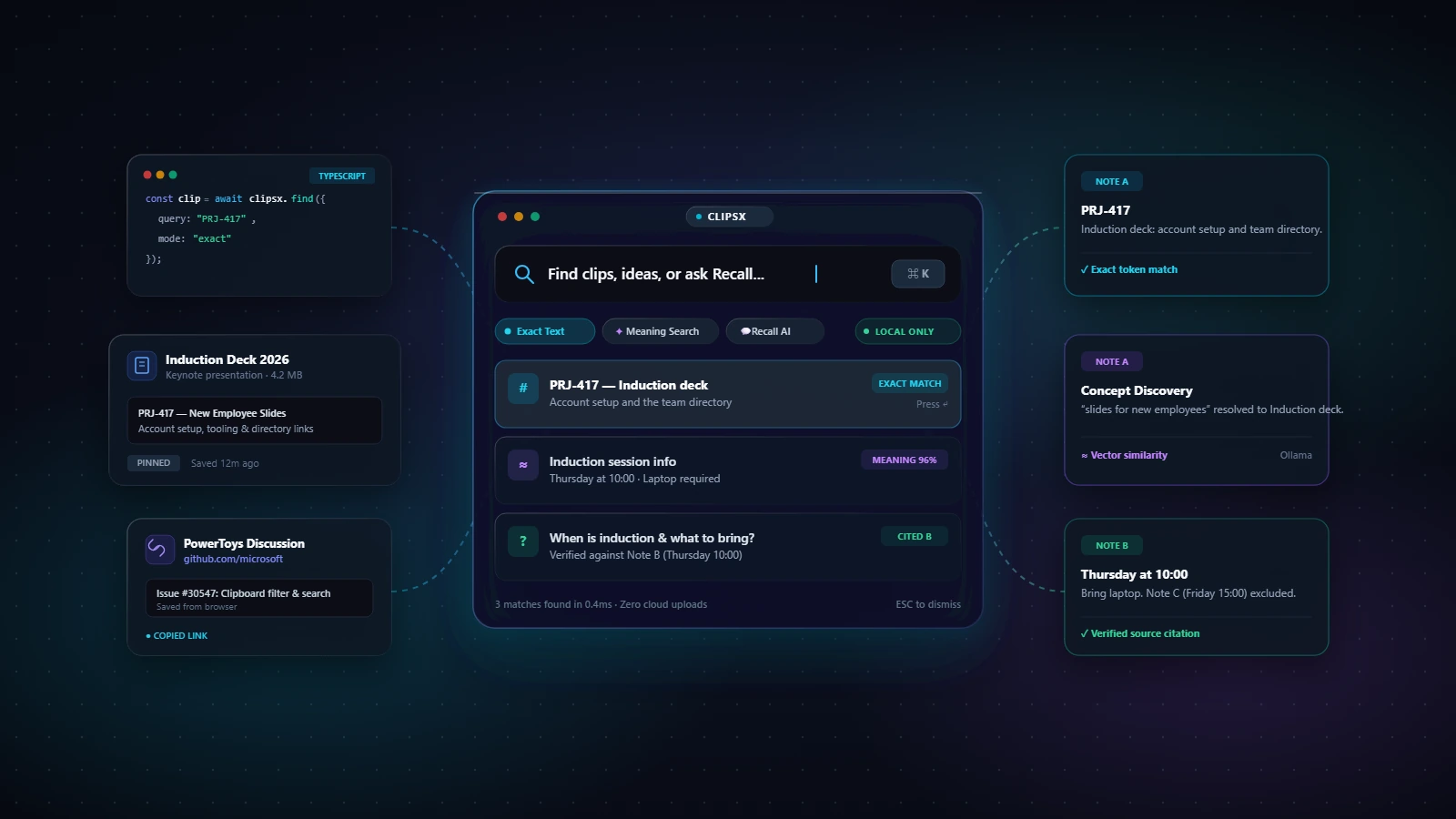
To view what you recently copied on Windows, press Windows + V. If you have Clipboard History turned on, Windows keeps a small tray of your latest clips.
However, when you need to dig up an email address from last Tuesday, find a code snippet you copied hours ago, or ask a question across your research notes, the built-in tool falls short. That is where ClipsX comes in: it turns your everyday copy-and-paste into an organized, instantly searchable personal knowledge archive.
Why does Windows clipboard history disappear?
If you have ever pressed Windows + V only to find what you were looking for is gone, you are not alone. Windows clipboard history is designed for immediate convenience, not long-term retention.
Microsoft imposes a strict 25-entry limit, a 4 MB cap per item, and clears all unpinned history whenever your computer restarts.
| Issue | What happened | How to resolve it |
|---|---|---|
| History is empty | Clipboard history was never turned on | Press Windows + V and click Turn on. |
| Old clips vanished | Reached the 25-item limit | New copies automatically push out older unpinned clips. |
| Computer restarted | System cleared volatile history | Windows removes all unpinned clips on reboot. |
| Image is missing | Exceeded the 4 MB item cap | Large screenshots or bitmaps over 4 MB are omitted. |
| Needed past item | Content was copied before capture | Clipboard tools cannot retroactively recover uncaptured data. |
If you only copy a couple of links each afternoon, Windows + V might be plenty. But if you write, code, research, or build presentations, a dedicated clipboard manager with persistent storage and full-text search saves hours of rework.
Three ways to search in ClipsX
Different tasks trigger different memories. Sometimes you remember the exact ticket number; other times you only remember a general topic or have a direct question. ClipsX provides three search tiers tailored to each situation:
- Exact Text Search — Instant matching for known words, codes, URLs, or identifiers.
- Meaning Search — Semantic vector retrieval that finds related clips even when wording differs.
- Recall — Intelligent AI synthesis that generates a direct answer backed by citations from your saved clips.
Beyond keyword search, ClipsX lets you organize clips with pins, custom tags, source app filters, and content types (code, rich text, images, and links).
Hands-on example: 1 note set, 3 ways to search
To see how search tiers adapt to what you remember, imagine you previously copied these three short notes:
- Note A:
PRJ-417 — Induction deck: account setup and team directory. - Note B:
Induction session: Thursday at 10:00. Bring your laptop. - Note C:
Brand review: Friday at 15:00. Bring the revised logo.
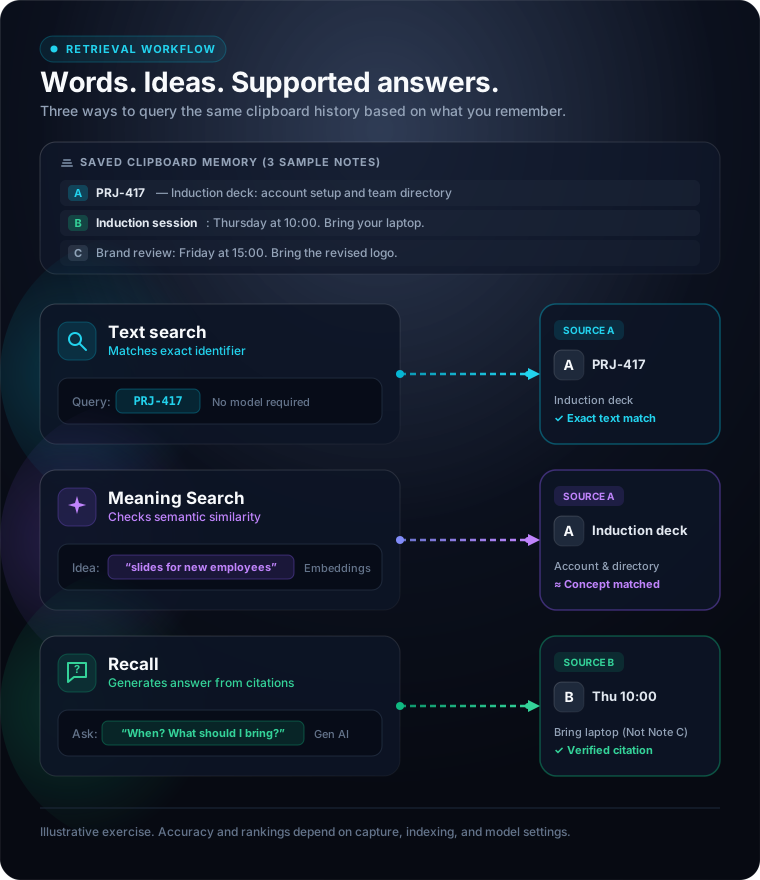
Notice how each search tool excels depending on your recollection:
| What you remember | Search mode | Example query | What ClipsX returns |
|---|---|---|---|
| Exact identifier | Text Search | PRJ-417 | Note A — Instant zero-latency match. No AI model needed. |
| Topic or concept | Meaning Search | "slides for new employees" | Note A — Resolves conceptual similarity via embeddings. |
| Specific question | Recall AI | "When is induction and what to bring?" | Note B — Generates answer citing Thursday 10:00 & laptop. |
When to use which mode
- Start with Text Search: For filenames, URLs, customer IDs, and error codes, exact text search is instant, consumes minimal battery, and runs entirely on your local CPU.
- Switch to Meaning Search: When you recall an idea (such as "that invoice from last month" or "the Figma onboarding link") but cannot remember the specific words used in the file.
- Use Recall for questions: When you need a synthesized summary across multiple clips with verifiable citations you can inspect with a single click.
Local-first privacy: Where your clips live
Clipboard history frequently contains sensitive data—from API keys and personal messages to proprietary documents. ClipsX is designed from the ground up with a strict local-first privacy model.
Your clipboard history is stored in an encrypted database directly on your device. Storage and AI processing are kept strictly decoupled:
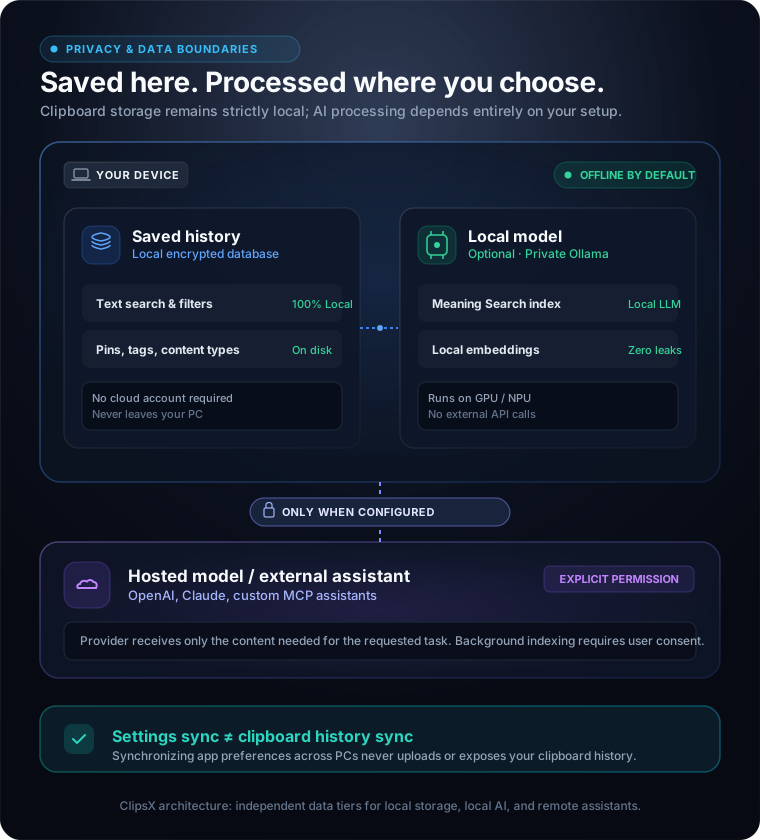
| Feature | Where it runs | Network activity | Privacy level |
|---|---|---|---|
| Core History & Search | On your local device | None (100% Offline) | Zero network exposure |
| Local Model (Ollama) | Local GPU / NPU | None (100% Offline) | Private local embeddings |
| Cloud Models (Optional) | OpenAI / Anthropic | Encrypted task API | Only sent when explicitly invoked |
| Settings Sync | Secure Cloud Sync | Encrypted preferences | Preferences only; clips never sync |
Key Takeaway: Syncing your app preferences across devices never uploads or synchronizes your clipboard history. Your clips stay on your machine.
Frequently asked questions
Can ClipsX recover clips copied before I installed it?
No. Clipboard managers can only store and index content copied while the application is active and running. If you lost an unsaved item before installing, check your browser history, chat logs, or document drafts.
Do I need an internet connection or an AI account?
No. All core clipboard capture, history management, and instant text search functions are completely offline. If you want Meaning Search offline as well, you can connect a local model via Ollama.
Can I filter by file type or app?
Yes. ClipsX lets you filter your history by source application (VS Code, Chrome, Slack, etc.) and content type (plain text, formatted rich text, code snippets, colors, and images).
Get started with ClipsX
A reliable clipboard manager transforms how quickly you move through your day. Instead of constantly re-opening files or asking teammates to resend links, everything you have touched is ready at your fingertips.
Download ClipsX for Windows and explore the Core Workflows guide to customize your shortcuts, tags, and search settings.